Writing their own answers. Learning how to improve them.
Your child works through a guided lesson and writes their own answers. I personally mark their work, give them feedback and set a focused task that puts my feedback to use.
I’m Alex, a practising teacher with 20 years’ classroom experience. Each week, your child has a clear task, a submission date and the same teacher reading their work: me.
✓Practise the answer they need to write.Personal feedback. A focused improvement.“
Personal teacher feedbackOn your child’s own work
Clear steps to improveModels, guidance and a fresh attempt
A structured curriculumFrom KS3 foundations to GCSE ambition
PREPARING FOR THE WORK THEY MUST DO THEMSELVES
In the exam, your child writes the answer.
Understanding an explanation is a start. They also need to turn that understanding into an answer of their own.
For pupils who will handwrite their GCSE or A-level exams, practice should include writing by hand. We work towards clear, developed answers in the format they will use, with agreed access arrangements respected.
AI can help explain an idea. Reading an answer it produces is different from learning to write one yourself. Here, your child does the thinking and writing, and I help them see what to improve.
Each guided lesson teaches a specific skill, shows a worked example and gives your child a chance to use it independently. For GCSE and A-level, I match the work to the confirmed course.
A teacher who knows their work
I personally mark their weekly submission and give them feedback. I explain what is working and where to focus next. Later work shows me whether they can apply that learning again.
Feedback they actually use
Your child makes a focused improvement, using my guidance and a model or checklist. They keep that revision, then apply the skill in their next pack.
Starting now gives them time to practise, receive feedback and use it again.
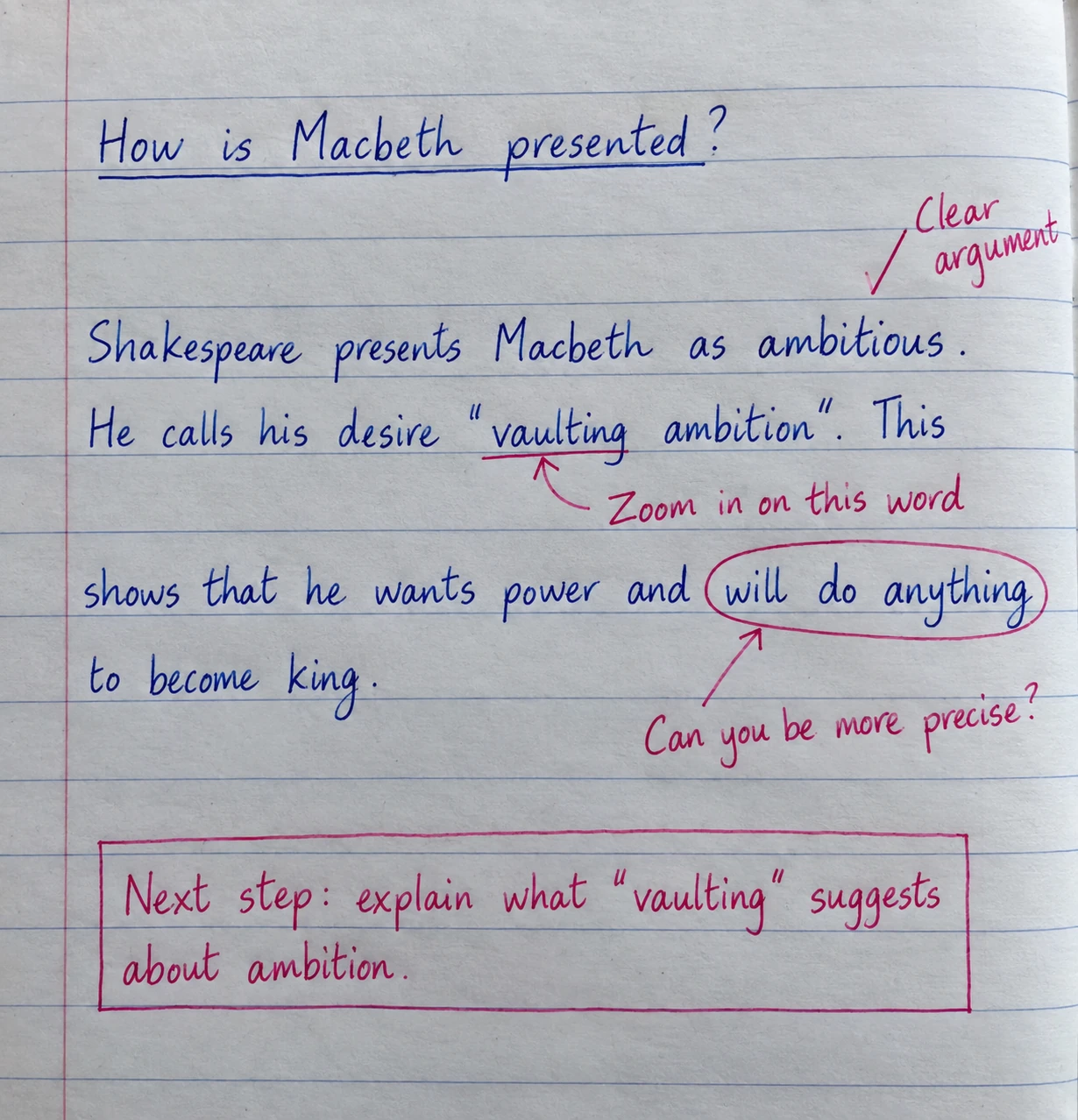
“Shakespeare presents Macbeth as ambitious. He calls his desire ‘vaulting ambition’. This shows that he wants power and will do anything to become king.”
The student has chosen relevant evidence. The next step is to explain what its language reveals.
Feedback that shows where to go.
Keep: the clear argument about ambition. Develop: what “vaulting” suggests. Refine: the sweeping claim “will do anything”.
“Explain the image of a leap. What happens when ambition ‘o’erleaps’ and ‘falls’?”
Now the word supports the argument.
“‘Vaulting’ presents ambition as an attempt to leap upwards. The movement from ‘o’erleaps’ to ‘falls’ suggests that Macbeth’s desire to rise could cause his collapse. He recognises the danger, yet chooses to pursue power.”
Then: practise explaining a significant word in a fresh passage. The teacher checks whether the student can use the skill independently.
FREE PRACTICE AT HOME
A small focus. A useful next step.
Start with Year 8: fifteen 10–15-minute boosters, arranged in five pathways, plus a separate reading list and further resources. Choose a skill or follow a sequence. Try the task, check the model and improve one part.
No account, uploads or marking required. The complete free first week includes Alex’s personal feedback on your child’s own work.
THE RIGHT STARTING POINT
Build the foundations. Raise the ambition.
One connected approach across Years 7–11. KS3 develops the knowledge and habits that GCSE English builds on; GCSE practice applies them to your child’s exam board and set texts.
Work towards Grade 9. One stronger answer at a time.
Ambitious GCSE tuition built around your child’s exam board. Explicit instruction, worked models, deliberate practice and personal feedback develop the precise analysis, convincing arguments and controlled writing that Grade 9 demands.
AQAPearson EdexcelOCREduqas
Select AQA, Pearson Edexcel, OCR or Eduqas when you enrol. We match practice to your child’s qualification, set texts, poetry collection and exam year, starting from what they can do now.
English Literature
Move from a quotation to a convincing interpretation. Develop arguments about the whole text, compare poetry and use context to deepen analysis.
Read unfamiliar texts closely, explain how language and structure work, and develop controlled creative and non-fiction writing for a clear audience and purpose.
We build from your child’s current level. Grade 9 is an ambition, not a guaranteed result.
Each week includes the learning pack, personal assessment, written feedback and a focused improvement task.
THE WEEKLY ROUTINE
Practise. Get feedback. Put it to work.
Around 60 minutes for the learning pack, followed by 15–30 minutes to read the feedback, make improvements and check the result. Extra practice is optional.
01
Learn and practise
Work through clear explanations, carefully explained models and focused reading and writing tasks. Complete the hour at once or in two 30-minute sessions.
02
Send the work
Email clear photos or scans of the completed pages. Parents organise and send; they do not need to teach or mark.
03
Receive personal feedback
I personally mark your child’s submitted work and give them feedback. I explain what is working, identify a clear priority and show them how to improve it, with a model or checklist to guide the next attempt.
04
Make the next attempt better
Read the comments, complete the essential improvement task and check it against the model or checklist. Allow around 15–30 minutes overall. Keep the revision for your own reference, then use the skill in the next pack.
A CURRICULUM FOR THE YEAR. FEEDBACK FOR THE CHILD.
The right challenge. Progress you can see.
A starting task shows what your child can do now. Their work helps their teacher decide what to focus on next.
Each year has a mapped sequence. Support and stretch adjust the challenge; at GCSE, the exam specification, set texts and time before the exams shape the priorities.
Personal feedback identifies a strength and one useful improvement. Your child revises the work, then uses the skill again in a fresh task.
After six completed feedback cycles: a progress summary. After twelve: a fuller report with examples and next steps.
“I can explain how a writer’s choice supports my interpretation.”
Introduced
Practising
Independent
Sustained
The evidence: a clear explanation of a carefully chosen detail in a fresh text.
THE NEXT CHALLENGE
Apply the same skill to a different passage. Two independent demonstrations, at least two weeks apart, support a teacher’s judgement of sustained success.
The passport records specific skills and examples from the student’s work. It is not a predicted GCSE grade.
PERSONAL TEACHING. FLEXIBLE STUDY.
One approach. A plan that fits.
Every plan includes the learning pack, personal marking, written feedback and a focused improvement task. Choose a single week or a longer block, with the same personal attention in each.
One-off payments. No automatic renewal. Optional extra practice is available between packs.
THE TEACHER BEHIND THE PRACTICE
Where feedback becomes learning.
I’m Alex.
I’m a practising teacher with 20 years’ classroom experience.
I have a degree in English Literature and a master’s in Philosophy. I created The English Practice to bring together a carefully designed curriculum, purposeful practice and feedback students can use.
I run the programme myself, personally mark each pupil’s submitted work and give them feedback. I keep places limited so I can give every pupil careful, individual feedback.
Start while there is time to practise, receive feedback and use it again. Your complete first week includes my personal marking and feedback of your child’s work.
A complete guided English lesson and workbook, with personal feedback from Alex and a focused task to put it into practice.
No card details. No automatic payments. No obligation to continue.
One complete lesson, workbook and feedback cycle per new student. Years 7–13. Alex confirms GCSE Literature and A-level course suitability before the free week begins.